
Commercial Solar for Not-for-Profit & Public Sector Organisations in Scotland
Charities, community organisations, faith buildings, schools and public sector facilities — solar that fits tighter budgets, trustee governance and a grant landscape commercial clients can't access.
Commercial solar PV for the Not-for-Profit & Public Sector sector
Not-for-profit and public sector organisations across Scotland face the same rising energy costs as commercial businesses — but with tighter budgets, trustee governance requirements, and, in many cases, access to grant funding that commercial clients simply cannot touch.
Caledonia Solar delivers commercial solar for charities, community organisations, faith buildings, schools, colleges, housing associations, and public sector facilities. We understand the governance frameworks, the grant landscape, and the procurement requirements specific to this sector. Our role is to make the process straightforward — from initial feasibility through to system commissioning.
This is not residential solar. We install commercial-grade systems sized to your actual energy consumption and roof capacity, backed by a full engineering, G99 grid connection, and project management process.
The energy challenges facing not-for-profit & public sector businesses
Not-for-profit and public sector organisations face energy cost pressure with structural constraints that commercial businesses do not — restricted budgets, trustee governance, complex VAT treatment and longer procurement timelines.
Restricted budgets squeezing core mission delivery
Energy costs consume an increasing share of restricted operating budgets, reducing funds available for core mission delivery. Every pound spent on grid electricity is a pound not spent on the service the organisation exists to deliver.
Trustee governance and capital approval friction
Trustee and governance boards require rigorous financial justification before approving capital expenditure. Procurement and decision timelines are longer than in commercial businesses — a delivery partner must understand governance timelines and trustee meeting cycles.
Grant funding complexity and missed eligibility windows
The grant funding landscape is complex and changes frequently. Without specialist support, eligible organisations miss windows they did not know existed. VAT treatment differs from commercial clients — qualifying not-for-profit installations may benefit from reduced or zero-rated VAT, which must be assessed and documented correctly.
Why commercial solar PV works for not-for-profit & public sector businesses
Many not-for-profit buildings are structurally well-suited to public sector solar PV. Community halls, faith buildings, schools, leisure centres, and sports clubs typically have large, unobstructed roof areas and significant daytime energy consumption — a strong match for solar generation profiles.
- Grant funding access CARES (Community and Renewable Energy Scheme), the Great British Energy public buildings programme and other Scottish grant routes are open to charities, community organisations and public bodies — and closed to commercial businesses. Grant cover of up to 80% transforms project economics.
- Favourable VAT position For organisations with charitable status, the VAT position may be more favourable than for commercial clients. Eligible installations can qualify for reduced or zero-rate VAT treatment, which materially improves the financial case.
- Building-type fit Community halls, faith buildings, schools, leisure centres and sports clubs typically have large unobstructed roof areas and significant daytime energy consumption — a strong match for solar generation profiles.
- Long horizons, low maintenance System lifespans of 25 years or more, low maintenance requirements, and the combination of grant funding with reduced energy bills from day one make solar a commercially robust addition to any not-for-profit building's financial model.
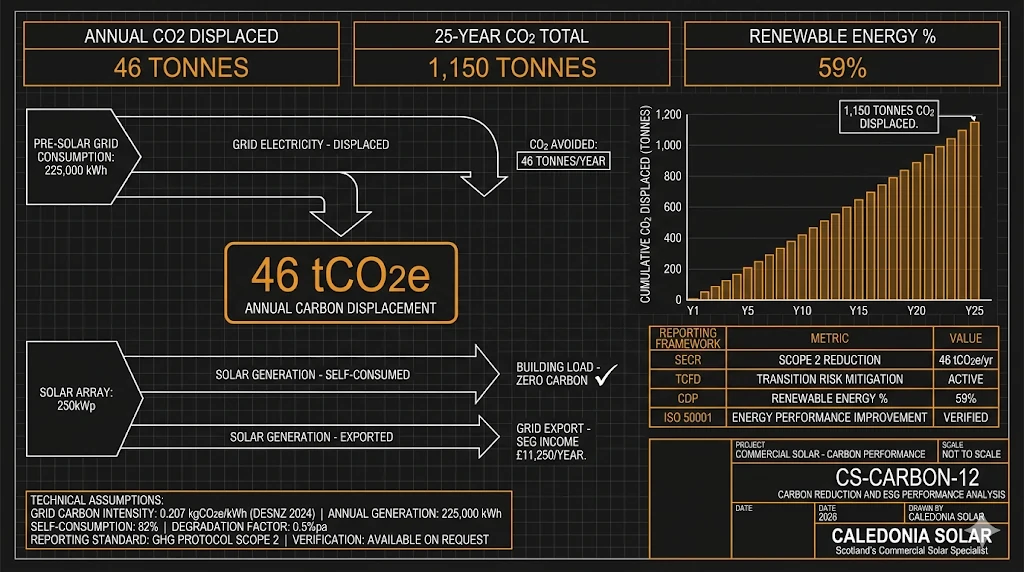
- Mandatory decarbonisation and ESG reporting For public sector organisations, commercial solar PV supports mandatory decarbonisation commitments, ESG reporting obligations, and demonstrates responsible stewardship of publicly-owned assets. An increasing number of funders and regulators expect to see active energy strategies in place.
For eligible organisations, the constraint is rarely whether solar works — but whether funding is secured in time.
What size commercial solar system does a not-for-profit & public sector business typically need?
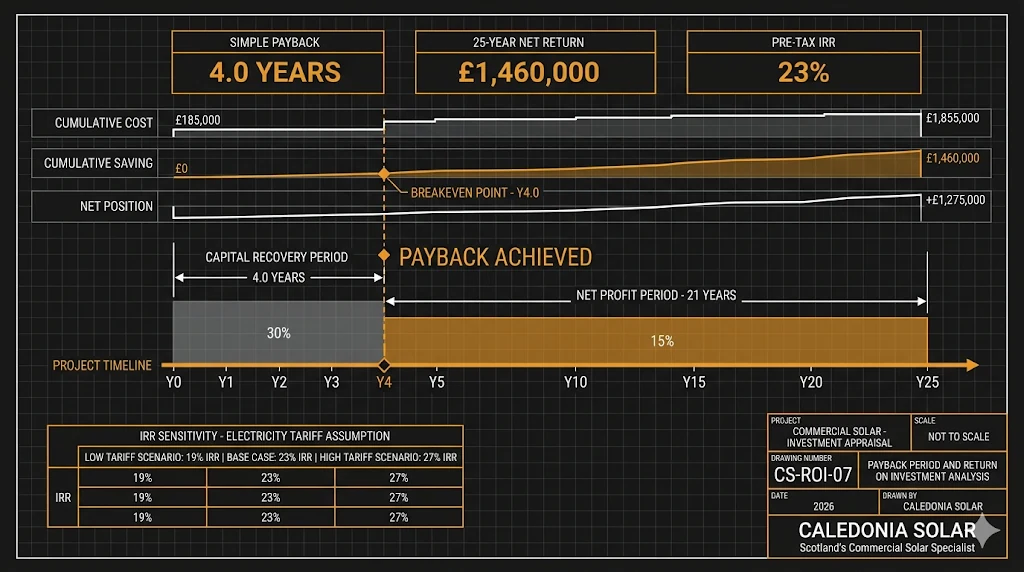
Systems for this sector range from 50kWp to 500kWp depending on building size, roof area, and consumption profile. All system sizes are modelled against actual consumption data and site assessment. Indicative benchmarks only.
Indicative Project Parameters
Funding a commercial solar installation in this sector
Not-for-profit organisations have access to several grant programmes that can substantially reduce or eliminate the capital cost of a solar installation — programmes that are not available to commercial businesses. CARES is a Scottish Government programme administered by Local Energy Scotland providing grants and loans to community organisations, charities and faith groups. The Great British Energy public buildings programme provides additional routes for schools, colleges and public sector facilities. Caledonia Solar can advise on which programmes your organisation may be eligible for and structure a project that maximises available funding.
Projects in Not-for-Profit & Public Sector
We are currently completing our first not-for-profit & public sector solar installations in Scotland. Case studies will be published here as projects are commissioned. If you would like to understand what solar could mean for your not-for-profit & public sector business in Scotland before case studies are published, please contact us directly.
Frequently asked questions
Can a charity get grant funding for solar panels in Scotland?
Yes. Registered charities and constituted community organisations in Scotland have access to several grant programmes not available to commercial businesses. The CARES Community Buildings Fund currently offers grants of up to £80,000 covering up to 80% of eligible solar installation costs. Eligibility depends on organisation type, building ownership or lease status, and available budget. Caledonia Solar can advise on which programmes your organisation may qualify for.
What is CARES and who is eligible for it?
CARES — the Community and Renewable Energy Scheme — is a Scottish Government programme administered by Local Energy Scotland. It provides grants and loans to help community organisations, charities, and faith groups install renewable energy in their buildings or develop community-owned energy generation projects. Private commercial businesses are not eligible for CARES grants, though they can work as delivery partners alongside eligible organisations.
Does Caledonia Solar work with schools and colleges?
Yes. Schools, colleges, and universities are a strong fit for public sector solar PV — large roof areas, high daytime energy consumption, and decarbonisation obligations. Schools may also be eligible for the Great British Energy public buildings programme. Caledonia Solar manages the full project process including system design, G99 grid application, and commissioning, working within education sector procurement and governance requirements.
Is VAT charged on solar panel installations for charities?
VAT treatment varies depending on the organisation’s VAT registration status and the nature of building use. Some qualifying not-for-profit installations benefit from a reduced or zero rate of VAT. Caledonia Solar ensures the correct VAT position is established as part of the project scoping process. Independent VAT advice is recommended where the position is complex.
What size solar system does a community building typically need?
System size is determined by actual electricity consumption and available roof area — not building type alone. A community centre with high daytime usage may support 50–150 kWp. A school may range from 100–300 kWp. A faith building with modest usage may suit 30–60 kWp. Caledonia Solar begins every project with a consumption analysis and site assessment before recommending a system size.
Can Caledonia Solar help us with the grant application process?
Caledonia Solar can advise on which programmes your organisation may be eligible for and help structure a project that aligns with grant criteria. For CARES applications, the fund administrator — Local Energy Scotland — provides direct support to applicants. We recommend making early contact with their team once your project is taking shape. We do not administer grant funds and cannot guarantee eligibility.
Model your financial position before trustee approval
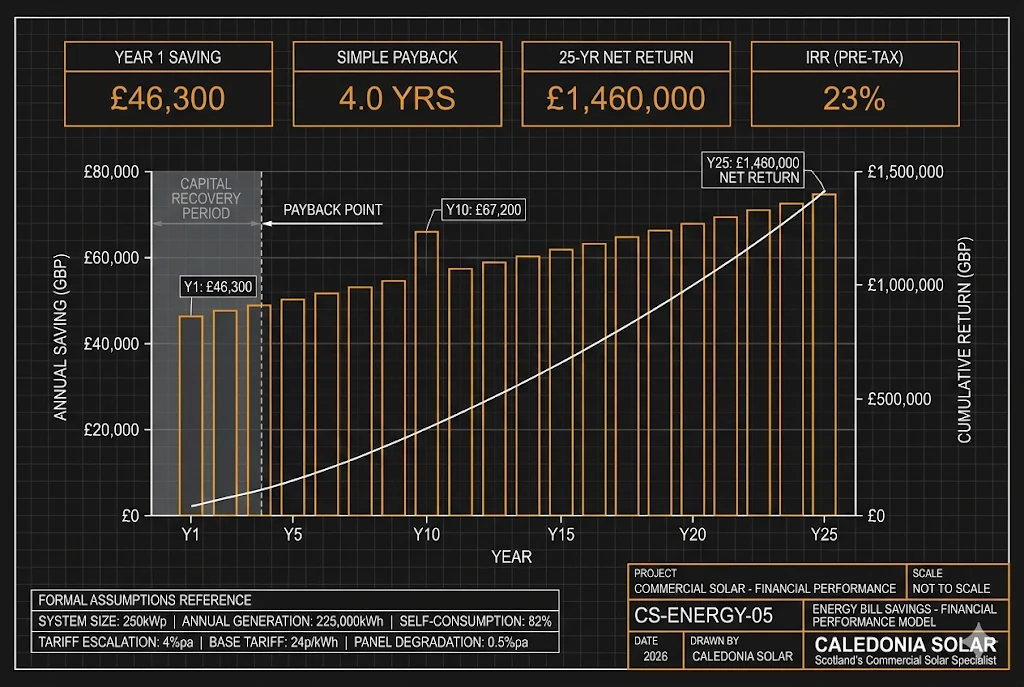
Even where grant funding covers a significant proportion of project cost, understanding your full financial position — residual capital requirement, ongoing bill savings, and simple payback period — is essential for trustee approval, board sign-off, and grant application supporting documentation.