
Commercial Solar for Scottish Hotels, Venues and Leisure Facilities
Energy is one of the largest controllable costs in hospitality operations. Commercial solar reduces that cost permanently, strengthens your sustainability credentials and meets the expectations of an increasingly eco-conscious guest base.
Commercial solar PV for the Commercial Solar for Scottish Hotels, Venues and Leisure Facilities sector
Scottish hotels, venues, leisure facilities and hospitality operators face an energy challenge that is structural rather than seasonal. HVAC systems, commercial kitchens, laundry, lighting and swimming pool heating run continuously, generating a high and relatively predictable energy demand across the operational day. As grid electricity prices have risen sharply, energy has become a material cost line in hospitality P&Ls across Scotland and the wider UK — directly affecting operating margins and competitive pricing.
Commercial solar PV addresses the daytime component of that energy cost directly. A well-specified rooftop system generates free electricity during daylight operational hours, reducing the proportion of energy purchased at grid tariff. Combined with battery storage, the benefit can extend into evening hospitality operations. Caledonia Solar designs hospitality solar projects around the specific operational profile of each facility — accounting for seasonal variation in occupancy, the mix of daytime and evening energy demand, and the roof and planning constraints specific to the property.
The energy challenges facing commercial solar for scottish hotels, venues and leisure facilities businesses
The energy challenges facing hospitality businesses
Energy as a structural margin challenge
Hospitality businesses operate on tight margins where energy cost movements translate directly into profitability. A medium-sized hotel spending £150,000–£300,000 per year on electricity has limited options for cost reduction other than reducing consumption — which conflicts with guest comfort and service standards. Solar permanently reduces the unit cost of a proportion of that electricity, improving margin without compromising the guest experience.
Guest and corporate sustainability expectations
Sustainability has moved from a differentiator to a requirement in hospitality. Corporate travel buyers, event organisers and increasingly leisure guests make venue selection decisions based on environmental credentials. Hotels and venues without a visible sustainability programme risk losing corporate accounts and MICE business to competitors with stronger ESG positioning. Solar is the most visible and impactful renewable investment available to a hospitality property.
Seasonal energy demand variation
Scottish hospitality operations face significant seasonal variation in both occupancy and solar generation — higher generation in summer aligned with higher occupancy, lower generation in winter when occupancy may also be lower. A well-designed system accounts for this seasonality and is sized to maximise self-consumption across the full year rather than just the peak summer months.
Why commercial solar PV works for commercial solar for scottish hotels, venues and leisure facilities businesses
Why commercial solar PV works for hospitality businesses
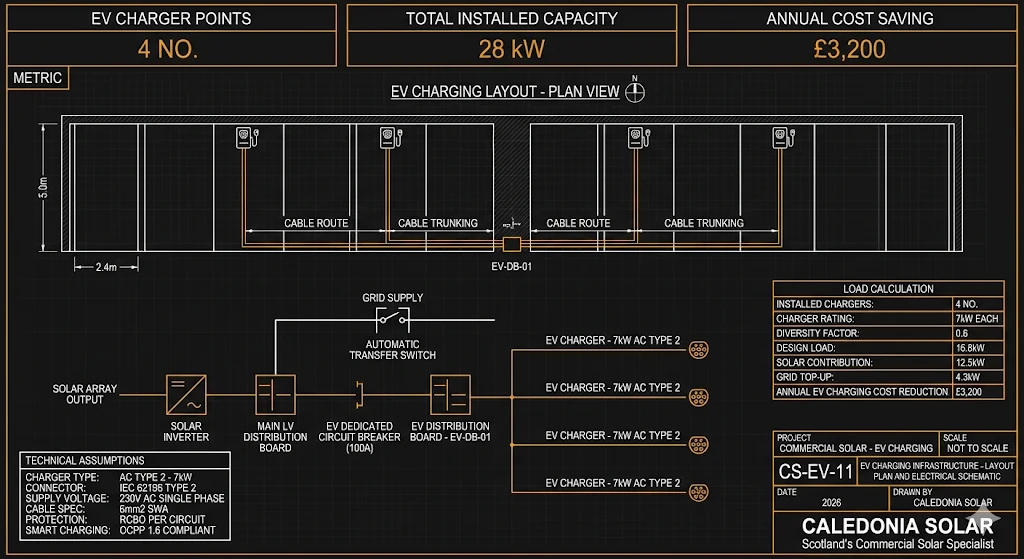
- Daytime operational alignment Hospitality buildings are energy-intensive during daylight hours — breakfast service, housekeeping, kitchen preparation and daytime leisure facilities all run during the solar generation window.
- Battery storage compatibility Hospitality operations benefit from pairing solar with battery storage to extend the benefit into evening dinner service, function operations and overnight stays.
- Planning-sympathetic solutions For listed or traditional Scottish hospitality properties, roof-integrated or ground-mounted systems can often be designed to achieve planning consent while delivering meaningful energy savings.
Every year without solar is a year of unnecessarily high energy operating costs and a missed opportunity to strengthen sustainability credentials in an increasingly competitive market.
What size commercial solar system does a commercial solar for scottish hotels, venues and leisure facilities business typically need?
What size commercial solar system does a hospitality building typically need?
Indicative Project Parameters
Funding a commercial solar installation in this sector
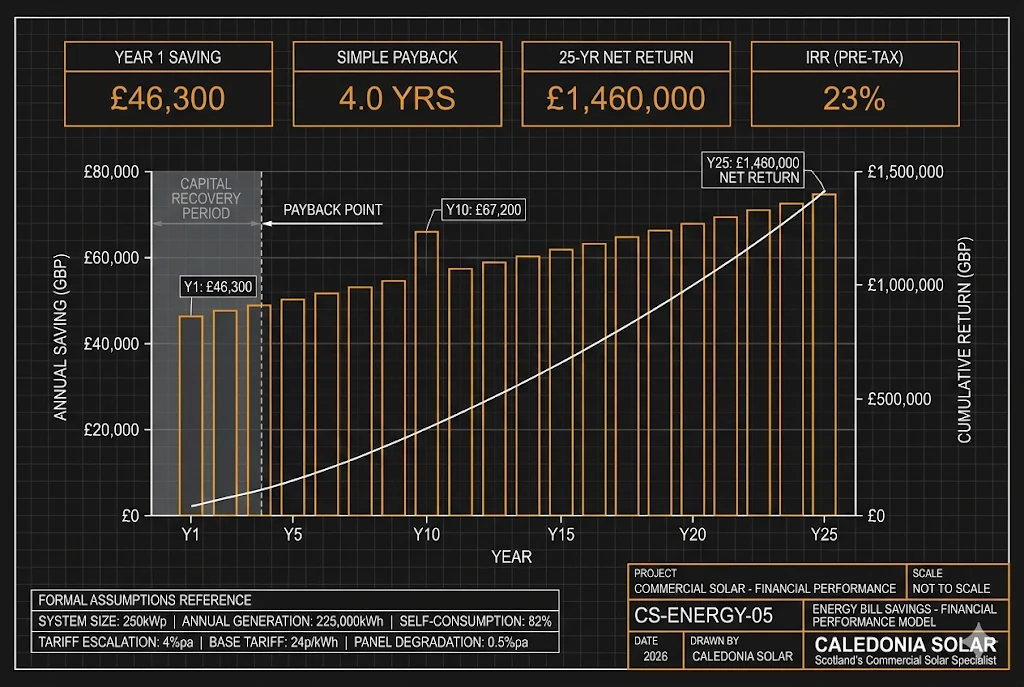
For hospitality owner-occupiers, CapEx purchase with Full Expensing provides the strongest long-term financial return. Asset finance is available for operators who prefer to preserve capital for room refurbishment, equipment replacement or expansion.
Power Purchase Agreements are available for larger hospitality properties where capital outlay is not preferred. Caledonia Solar models all three funding routes and presents comparative financial outcomes before any commitment is required.
Projects in Commercial Solar for Scottish Hotels, Venues and Leisure Facilities
We are currently completing our first commercial solar for scottish hotels, venues and leisure facilities solar installations in Scotland. Case studies will be published here as projects are commissioned. If you would like to understand what solar could mean for your commercial solar for scottish hotels, venues and leisure facilities business in Scotland before case studies are published, please contact us directly.
Frequently asked questions
Does solar work for a hotel with high evening energy demand?
Daytime solar generation directly offsets daytime hospitality energy consumption — commercial kitchens, housekeeping, leisure facilities and daytime guest services. For operations with high evening energy demand — dinner service, function rooms, bar and entertainment — pairing solar with a battery storage system allows excess daytime generation to be stored and used in the evening. Caledonia Solar models both solar-only and solar-plus-storage scenarios for hospitality clients.
Can solar be installed on a traditional Scottish hotel building?
Many traditional Scottish hotel buildings are listed or in conservation areas, which requires a planning application rather than relying on permitted development rights. The feasibility of solar depends on the specific listing, the character of the building and the proposed installation method. Roof-integrated systems that minimise visual impact are more likely to achieve listed building consent. For some traditional properties, ground-mounted systems in ancillary areas may be a more appropriate option. Caledonia Solar can advise on the planning position for a specific property.
How can a hotel demonstrate its solar credentials to corporate clients?
Corporate travel managers and event buyers increasingly require venues to provide verified data on energy and carbon performance. A solar system with generation monitoring provides documented evidence of renewable energy generation that can be reported against corporate sustainability frameworks. Caledonia Solar can advise on monitoring options and data formats suitable for corporate sustainability reporting, including annual generation certificates where required.
What is the payback period for hotel solar in Scotland?
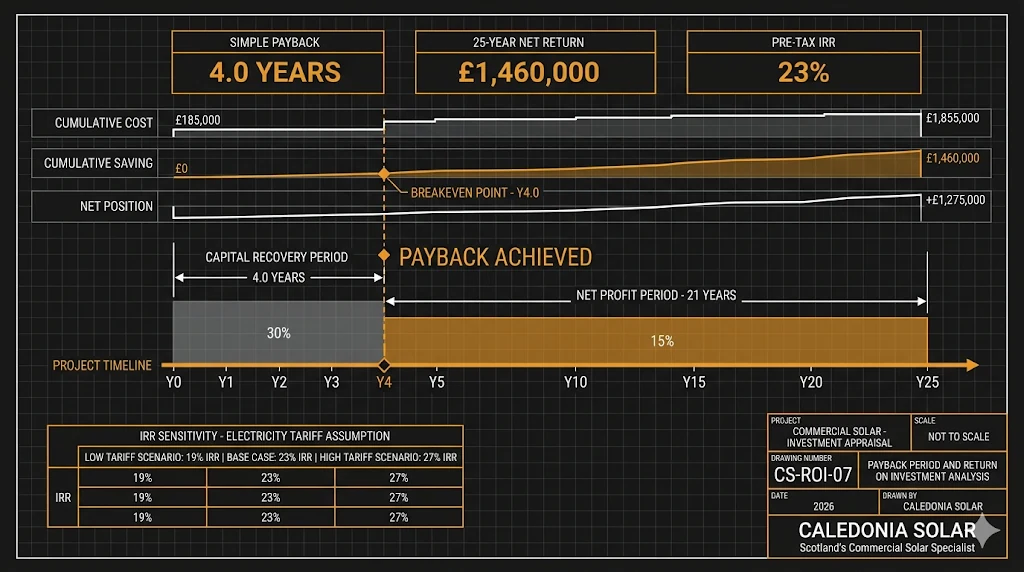
Payback periods for hotel solar in Scotland depend on system size, energy tariff, occupancy profile and funding model. For a CapEx purchase by a well-occupied hotel with suitable roof area, payback periods of 6–10 years are typical at current electricity prices, with strong financial returns over the 25-year system life. Asset finance typically delivers positive cash flow from early in the agreement period. Caledonia Solar provides a full financial model for your specific property before any commitment is required.
Find out what solar is worth for your hospitality business
Enter your property’s roof area and monthly energy bill for an indicative saving estimate. For a full hospitality energy model including seasonal variation and battery storage options, speak to our team directly. Get a Free Savings Estimate