
Commercial Solar Funding — Three Routes, One Recommendation
CapEx purchase, asset finance or fully funded PPA — Caledonia Solar structures the right deal for your business and places it directly through our panel of five specialist commercial solar funders.
For many businesses, the funding structure is more important than the system itself. A poorly structured commercial solar project can tie up capital unnecessarily, create the wrong tax outcome, or leave a business exposed to a lease it cannot exit. Getting the funding right from the start is as important as getting the design right.
Caledonia Solar works with five specialist commercial solar funders — Octopus Energy, Siemens Financial Services, Ortus Energy (part of SSE) and Soventix — and places funding directly without introducing a broker into the chain. We present all three funding routes transparently, model the financial outcomes of each, and make a clear recommendation based on your specific circumstances.
This page explains how each funding model works, who it suits, and what questions to ask before committing.
Three ways to fund a commercial solar installation
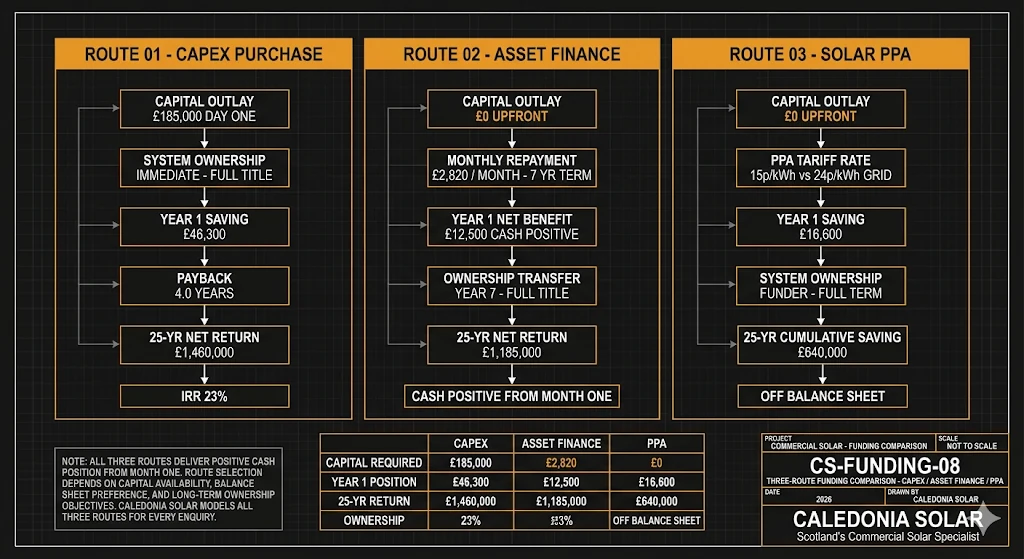
CapEx purchase — own the asset outright
Maximum financial return. Full asset ownership from day one.
A CapEx purchase means your business funds the installation directly from capital and owns the solar system as a fixed asset from the day it is commissioned. You benefit from the full value of the electricity generated, capital allowances under the Annual Investment Allowance or Full Expensing, and the long-term appreciation of the building asset.
For businesses with available capital and a long-term commitment to their premises, CapEx typically delivers the strongest financial return over a 25-year horizon. The payback period on a well-specified commercial system in Scotland is typically 5–8 years, after which the system generates free electricity for the remainder of its operational life. Ownership also means full responsibility for maintenance and performance over the system life.
Best suited to:
Businesses with available capital or strong balance sheet
Owner-occupiers planning long-term building occupation
Businesses seeking to maximise capital allowance utilisation
Larger installations where the long-term return justifies upfront cost
Consider if:
Your business is leasehold with fewer than 10 years remaining, or capital is better deployed in core business activity.
Asset finance — spread the cost
Preserve capital. Typically cash-flow positive from day one.
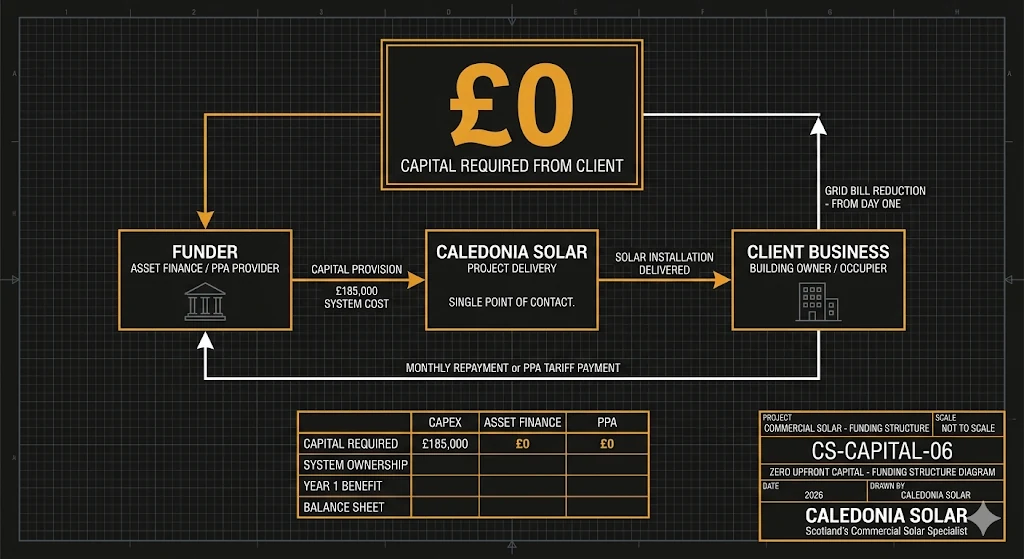
Asset finance allows your business to fund the full installation cost through a structured finance agreement, typically over 3–7 years. The solar asset is used as security for the finance, keeping your existing credit facilities free. Monthly payments are fixed at the outset, giving full cost certainty for the duration of the agreement.
For most commercial solar projects in Scotland, the monthly saving on electricity bills exceeds the monthly finance payment from the point the system is commissioned — in many cases making the project cash-flow positive from day one. At the end of the finance term, your business owns the asset outright.
Best suited to:
Businesses that want to preserve working capital or credit facilities
Businesses where the monthly saving is expected to exceed the finance payment
Owner-occupiers or long-term leaseholders
Businesses that want asset ownership at the end of the term
Consider if:
Your business has a short lease term, uncertain future occupation plans, or the finance payment would materially exceed the electricity saving in early years.
Power Purchase Agreement (PPA) — zero capital outlay
No upfront cost. Immediate savings. No asset ownership required.
A Power Purchase Agreement removes the capital requirement entirely. A specialist third-party funder designs, owns and installs the solar system on your roof at no cost to your business. You enter a long-term agreement — typically 10–25 years — to purchase the electricity the system generates at a fixed rate below your current grid tariff.
The saving is immediate and guaranteed by contract. You do not own the asset, but you are not responsible for maintenance, insurance or performance risk — these remain with the funder. A PPA is the right structure for businesses where capital preservation is the priority, or where the building owner and the energy user are different entities. The agreed electricity rate may include an annual escalation, which is modelled and presented in full before any agreement is signed.
Best suited to:
Businesses where capital outlay is not possible or not preferred
Businesses with long leases where landlord consent for installation is available
Situations where the building owner and occupier are separate parties
Businesses seeking a guaranteed, contracted energy rate with no maintenance obligations
Consider if:
You want to own the asset, your lease term is shorter than the PPA term, or you are planning to sell the building within the agreement period.
TABLE INTRODUCTION
The table below summarises the key characteristics of each funding model. All financial figures are indicative and depend on system size, energy tariff, finance terms and individual business circumstances. Caledonia Solar provides a full financial model for your specific situation as part of the initial assessment.
CapEx purchase
Asset finance
Power Purchase Agreement (PPA)
Upfront capital required
Full project cost
None
None
Asset ownership
Immediate, full
At end of term
Funder retains ownership
Typical term
Permanent
3–7 years
10–25 years
Monthly obligation
None after purchase
Fixed finance payment
Per-unit electricity rate
Cash-flow impact
Positive after payback
Typically positive from day one
Positive from day one
Typical payback period
5–8 years
N/A (financed)
N/A (no capital outlay)
Capital allowances
Yes (AIA / Full Expensing)
Depends on structure
No — funder claims
Maintenance responsibility
Building owner
Building owner
Funder
Exit flexibility
Full — you own the asset
Subject to finance terms
Subject to PPA agreement
Best suited to
Long-term owner-occupiers with capital
Businesses preserving capital
Zero-capex requirement
Scottish grants and incentive schemes for commercial solar
SECTION INTRO COPY
Scottish businesses may be able to reduce the net cost of a commercial solar installation through grant funding or incentive schemes administered at Scottish Government, local authority or sector level. The availability of grant funding changes regularly — schemes open and close throughout the year, and eligibility criteria vary significantly by sector, location and project size.
Caledonia Solar reviews grant eligibility as part of every initial consultation. The entries below reflect the position at the date shown — verify current availability before making any investment decision.
DISCLAIMER (DEVELOPER: RENDER IN MUTED TEXT BENEATH SECTION)
Grant information is provided for general guidance only and is subject to change. Caledonia Solar does not administer grant schemes and cannot guarantee eligibility or funding availability. Independent verification is recommended before relying on grant funding as part of a project financial model.
PLACEHOLDER GRANT ENTRIES — DEVELOPER TO MAKE ACF-EDITABLE
Entry 1: Resource Efficient Scotland
Description: Scottish Government programme providing free expert advice to businesses on energy efficiency and renewable energy. Can include assessment support and, in some cases, capital grant contribution for qualifying projects. Eligibility: Scottish-registered businesses. Status: Active — verify current terms. Last verified: March 2026.
Entry 2: Agricultural sectors — SRDP and rural funding
Description: Scottish Rural Development Programme and successor rural funding schemes may include capital support for renewable energy installations on agricultural holdings. Eligibility: Agricultural businesses and rural land managers in Scotland. Status: Check current round status with Scottish Government rural payments. Last verified: March 2026.
Entry 3: Local authority and regional schemes
Description: Some Scottish local authorities and regional bodies offer business energy improvement grants or low-interest loan schemes that may be applicable to commercial solar projects. Availability varies significantly by council area. Eligibility: Businesses registered and operating in the relevant local authority area. Status: Varies — consult local authority economic development team. Last verified: March 2026.
The funders we work with
SECTION INTRO COPY
Caledonia Solar has established funding relationships with five specialist commercial solar funders. We place funding directly — no broker intermediary, no referral fee added to your project cost.
Octopus Energy — One of the UK’s leading energy businesses, with a commercial solar funding arm focused on PPA and asset-backed structures for larger commercial installations.
Siemens Financial Services — Specialist asset finance for commercial and industrial renewable energy projects. Strong track record in manufacturing and logistics sector installations.
Ortus Energy (part of SSE) — Commercial solar funding capability developed through Ortus Energy prior to their acquisition by SSE. Full-spectrum funding including PPA, lease and asset finance.
Soventix — European commercial solar developer and funder with UK project experience across industrial and commercial rooftop installations.
Where a project does not fit the criteria of our existing funder panel, we will say so clearly and advise on alternative routes rather than forcing a fit.
How Caledonia Solar structures and places your funding
STEP 1: FINANCIAL ASSESSMENT
We review your energy consumption, building tenure, financial position and tax circumstances to establish which funding model is likely to be most advantageous for your business.
STEP 2: OPTIONS MODELLING
We produce a comparative financial model showing the 10 and 25-year outcomes under each viable funding route — CapEx, asset finance and PPA where applicable — with indicative figures for each scenario. We present this in a format suitable for internal approval, including board-level review where required.
STEP 3: FUNDER SELECTION AND APPLICATION
We identify the most appropriate funder from our panel, prepare the application and manage the process through to credit approval. We do not charge a funding placement fee to your business.
STEP 4: DOCUMENTATION AND DRAWDOWN
On credit approval, we manage the legal documentation process alongside your solicitor where required, coordinate the finance drawdown with the installation programme, and ensure all compliance obligations are met before the project proceeds.
Frequently asked questions
What is a solar PPA and how does it work for a commercial business?
A Power Purchase Agreement (PPA) is a long-term contract between a business and a specialist solar funder. The funder designs, installs and owns a solar system on the business’s roof at no upfront cost. The business then pays for the electricity the system generates at a rate fixed below the prevailing grid electricity tariff. The saving is immediate, contractually guaranteed, and requires no capital outlay from the business. PPA terms typically run for 10–25 years, after which the business may have the option to purchase the system, extend the agreement or have the system removed.
Can a business get commercial solar with no upfront cost in Scotland?
Yes. A Power Purchase Agreement (PPA) requires no upfront capital from the business. The solar system is funded, installed and maintained by a third-party funder. The business pays only for the electricity generated, at a rate below the grid tariff, from the point the system is commissioned. Alternatively, asset finance allows the full installation cost to be spread over 3–7 years with no upfront payment, with monthly finance payments typically offset by electricity savings from day one.
How does asset finance work for commercial solar?
Asset finance for commercial solar works similarly to equipment finance. The full installation cost is funded by a specialist finance provider, with the solar asset used as security. The business repays the cost in fixed monthly instalments over an agreed term, typically 3–7 years. At the end of the term, ownership transfers to the business. For most commercial solar projects, the electricity savings generated by the system exceed the monthly finance payment, making the project cash-flow positive from the point of commissioning.
What tax benefits are available for a commercial solar purchase in Scotland?
Businesses purchasing commercial solar systems outright can claim capital allowances under the Annual Investment Allowance (AIA) or Full Expensing, subject to current HMRC rules and allowance limits. The system qualifies as plant and machinery. VAT on commercial solar installations is currently zero-rated until March 2027 under current UK tax rules. Businesses should take independent tax advice on their specific circumstances before making an investment decision. Caledonia Solar does not provide tax advice.
What is the difference between a solar lease and a solar PPA?
Under a solar lease, a business rents the solar equipment and pays a fixed monthly lease payment regardless of how much electricity the system generates. Under a Power Purchase Agreement, the business pays only for the electricity the system actually generates, at a fixed per-unit rate. For most commercial applications, a PPA is preferable to a lease because the payment is directly linked to generation output and the business benefits from any overperformance of the system relative to projections.
Does the building owner or the tenant fund the solar installation?
This depends on the building tenure and the preferred funding model. For owner-occupiers, all three funding routes are available. For leasehold occupiers, a PPA can be structured with the funder taking a licence on the roof from the building owner, with the business benefiting from the electricity savings. Some landlord-funded models also exist where the landlord installs the system and passes the savings to the tenant through a service charge or green lease arrangement. Caledonia Solar advises on the appropriate structure for your specific tenure situation.
See what each funding model means for your business
Our calculator lets you compare the financial outcome of CapEx purchase, asset finance and PPA side by side — using your actual roof size and energy consumption. No personal details required for an initial estimate. Compare Funding Options with Our Calculator